
Wine X Staff
Wine X Magazine Online Edition
This is the first in a series of Wine X dispatches checking in on harvest across different wine regions, one winery and one vintage story at a time.
There’s the harvest you picture from a tasting-room patio. Golden light. Full grape bins. Someone in boots looking thoughtfully across the vines. Then there’s the harvest where the next vineyard is ready to pick and you’re still figuring out how to get a fermentation tank emptied.
Titus Vineyards got the second one this year.
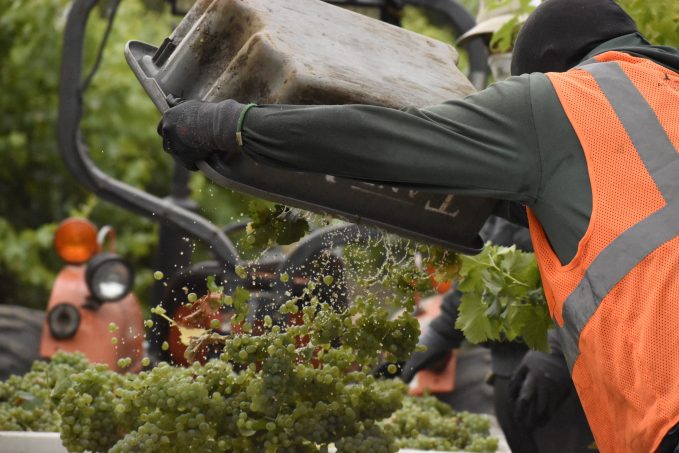
At the family-owned St. Helena winery, Sauvignon Blanc started coming in on August 5. The reds followed on September 1, and by October 2, the last Cabernet Sauvignon from Titus Ranch had arrived. An entire red-grape harvest packed into barely more than a month.
“If I had to choose one word to describe harvest this year, it would be ‘sprint,’” winemaker Charles McKahn says in the winery’s harvest report. “Usually, harvest is much more spread out. It was a sprint to get the tanks cleared so we could bring in more grapes.”
Anyone who has tried to cook Thanksgiving dinner with one oven understands the basic problem. Now imagine the ingredients get to decide when dinner starts.
Titus wasn’t alone in finding 2026 ahead of schedule. According to Visit Napa Valley, Round Pond Estate began picking Chardonnay for sparkling wine on July 21. CHANDON followed on July 24 with what it reported as the earliest first pick in its 53-year history. Summer vacation was still very much a thing. Harvest had already clocked in.
By late September, the San Francisco Chronicle was reporting early picks elsewhere, including Shafer’s August 25 start for Chardonnay at its Carneros vineyard, almost a month ahead of the previous year. The same reporting described a season in which early growth and disrupted fruit set helped produce smaller crops, followed by a comparatively mild summer.
At Titus, proprietor and vineyard manager Eric Titus describes an early spring, early veraison, the stage when grapes begin changing color and ripening, and an even-tempered growing season. That sequence matters. An early harvest date alone tells you very little about what the wine will taste like. The conditions that brought the fruit to that date tell you considerably more. And the fruit still has to pass the taste test.
McKahn’s team tracks sugar, acidity, pH and seed color, alongside flavor. A lab number can tell you something useful about a grape. It cannot make the entire picking decision for you. In 2026, the challenge was keeping up as different lots reached that decision point in quick succession. There was less fruit to manage, although that apparently did nobody’s schedule any favors.
Titus reports yields roughly 24 percent below 2025, with fewer and smaller clusters. McKahn points to shatter, or poor fruit set, at some vineyards. The estates experienced relatively little shatter, but cluster counts and weights were still below average, with older vineyards coming in noticeably lighter. Smaller crop. Same expectation for the wine.
During red-wine fermentation, contact with grape skins helps build color, tannin and flavor. This year, McKahn reports that extraction moved more slowly. The fruit was arriving quickly, but the wine developing inside the tanks needed time. You can see the scheduling problem. The next pick needs somewhere to go. The current lot needs the attention and skin contact appropriate to the wine. A harvest calendar can accelerate. The cellar still has to work lot by lot.
Titus picks at night and in the early morning, bringing cool grapes over the short distance to the winery. Most of its fruit comes from two estate vineyards, one surrounding the winery and another about a mile away on Ehlers Lane. That proximity helps preserve the benefit of a cool pick and reduces the need to chill the fruit after arrival.
There’s a longer view here, too. The Titus family’s first harvest was in 1969. Along the winery estate’s western edge, the Napa River borders a riparian habitat Eric Titus has worked to protect. The property also has a working vineyard frost fan installed in 1952, a machine called “Tropic Breeze” that sounds ready for a second career as a poolside cocktail.
According to the winery, it stayed off this growing season. No killer frosts required its services. The cellar team had considerably less downtime.
“At that point we have the most important work still to do,” McKahn says of bringing in the final grapes. “Fermentations keep us hopping for several weeks, providing that magic that all of us love.”
So what should we expect in the glass? Eric Titus sees reason for optimism in the combination of an early harvest and a light crop. Fair enough. But a harvest report is an opening chapter, and we’ll leave the tasting notes until there’s something ready to taste.
The first opportunity should be the estate Sauvignon Blanc, which Titus expects to release in summer 2027. The grapes arrived in a hurry. We’ll have to be more patient.