Wine X Editorial staff
Wine X Online Edition
We said Part III was the end. Then this week happened.
We weren’t planning a Part IV.
We had written three stories, read more Napa County land-use documents than is probably healthy, and called the series finished. Then September 30 happened.
Smith-Madrone and Summit Lake filed three new motions in federal court asking Judge Charles Breyer to step in now, while their larger constitutional case against Napa County continues. One involves wine tastings. Another involves winery gatherings. The third involves a potentially very expensive road.
Then some of the exhibits started getting interesting.And then Stu Smith found a newspaper from 1984. So, apparently, we weren’t done.
If you’ve read Parts I through III, we’re not going to make you sit through them again. The only reminder you need is this: Smith-Madrone and Summit Lake are among the wineries challenging aspects of Napa County’s regulatory system in federal court. Napa disputes their allegations. This week, that fight became considerably more specific. And considerably more interesting.
STU SMITH FOUND 1984
Somewhere in the Smith-Madrone archives was a copy of the July 18, 1984, San Francisco Chronicle.
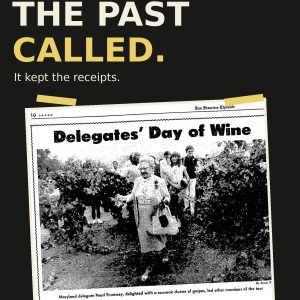 Stu Smith found it. The story concerns a bus carrying 50 Democratic National Convention delegates and spouses into wine country. Things did not go well at first. The driver got lost. Repeatedly.
By the time the bus reached Smith-Madrone on Spring Mountain, the passengers were apparently approaching mutiny. One delegate called the narrow dirt-and-gravel road leading to the winery “insane.”
Then they got off the bus. And everything changed. Stu led the group on a 45-minute walk through the vineyard, talking about the grapes growing on the mountain. They made a stop inside the small redwood winery. Then they headed to the lawn, where Susan Smith had eight red, white and blue-covered tables waiting for lunch. Cold pasta salad. Cantaloupe. Watermelon. Ice cream with fresh blueberries.
And, presumably to everyone’s great relief, wine. The Chronicle even noted one final detail. The Smiths were Republicans. That’s really not a material part of the story, we just thoughh it was funny. Apparently Cabernet once qualified as bipartisan infrastructure.
The article sat around for 42 years. Then Stu pulled it out this week.
AND THAT’S WHY THERE’S A PART IV
The clipping doesn’t prove Smith-Madrone’s legal case. It doesn’t establish that Napa County approved that particular gathering. It doesn’t define the legal boundaries of Smith-Madrone’s 1973 use permit. And it doesn’t tell Judge Breyer how to rule. But it does give us something we didn’t have when we finished Part III.
A contemporaneous receipt.
Not Stu remembering what happened four decades ago.
Not a declaration prepared for litigation.
Not a county administrator creating context by reconstructing winery history from old documents.
A reporter was there.
About 50 people arrived by bus. Stu walked them through the vineyard. They visited the winery. Susan served lunch on the lawn. And that matters because one of the new motions filed this week asks a federal judge to protect what Smith-Madrone says are longstanding rights to conduct private, by-appointment tastings.
The legal question is considerably more complicated than one newspaper clipping. But the factual picture just became considerably less abstract.We’re no longer simply asking what somebody thinks happened at Smith-Madrone decades ago. We can read about one afternoon in 1984. Somebody kept the clippings.
THEN THREE MOTIONS HIT THE DOCKET
On September 30, three preliminary-injunction motions were filed in the federal case.
 A preliminary injunction is essentially an argument that waiting for the entire lawsuit to end isn’t good enough. The plaintiffs want the judge to intervene while the litigation continues.
The three new motions concern wine tastings, winery gatherings and Summit Lake’s road dispute.
And taken together, they sharpen something we’ve been circling throughout this series. Not simply whether Napa County has rules. Of course it does. Not whether Napa should regulate winery development, traffic, fire access and land use. Of course it should.
The more interesting question is whether the person being regulated can reliably determine where the regulatory boundary actually sits. Because this week’s motions put three very different versions of that question in front of the same federal judge.
SMITH-MADRONE: SHOW ME WHERE THE LINE IS
Smith-Madrone says its 1973 permit allows private, by-appointment tastings and doesn’t contain the numerical visitor cap the County now associates with the property. Napa disputes the wineries’ broader characterization of its regulatory system. Judge Breyer will eventually have to sort through the legal arguments. But Stu’s newspaper clipping gives the dispute a wonderfully tangible new dimension.
Smith-Madrone isn’t a hypothetical winery. Stu Smith has been on this mountain since 1971. And now, while lawyers are debating the scope of a permit issued in 1973, he has produced a newspaper from 1984 showing what at least one day of winery visitation actually looked like. Again, that doesn’t prove what was legally permitted. But if you’re trying to reconstruct history, finding history is generally useful.
SUMMIT LAKE: SHOW ME HOW YOU GOT TO $2 MILLION
The road motion asks a very different question. Summit Lake says Napa is requiring more than $2 million in improvements to the private road serving its property in connection with the winery’s approval process.
 According to the winery’s motion, the County’s road concern reflects the cumulative traffic of more than a dozen properties using the road. Summit Lake argues that the day-to-day operations it is proposing wouldn’t add a single additional vehicle to existing traffic.
Napa has perfectly legitimate reasons to care about roads. Anyone who has driven Napa’s mountain roads knows that “two lanes” can occasionally be more of a philosophical concept. Fire access matters. Emergency vehicles matter. Traffic matters.
But Summit Lake isn’t arguing that roads don’t matter.
Its new motion asks whether this particular property can be required to shoulder more than $2 million in improvements when the problem the County identifies is substantially attributable to traffic generated by other properties. That’s a different legal issue from Smith-Madrone’s tasting dispute.
But from the property owner’s side of the counter, there is a striking similarity.
Show me the line.
Show me the rule that applies.
Show me how you interpreted it.
Show me how you got from my proposal to this requirement.
And if the answer is going to cost me more than $2 million, it would be nice if I could see the line before I step over it.
AND THEN THERE ARE THE EVENTS
The third new dispute involves winery gatherings.
The plaintiffs contend Napa’s rules and interpretations distinguish among activities such as harvest celebrations, winemaker dinners, food-and-wine pairings and other gatherings in ways that give the County too much discretion over what requires additional approval.
Napa’s position is that winery activities remain governed by each property’s lawful entitlements and applicable land-use rules. Again, Judge Breyer gets the hard part.
But now we’ve got tastings, gatherings and a road sitting in front of the same judge at the same time. They aren’t the same legal claim. They don’t need to be. Because the practical question underneath them is beginning to look awfully familiar.
Where is the line?
THEN THE EXHIBITS STARTED TALKING
This is where the new filings became more interesting than we expected.
Because alongside the wineries’ arguments are older government records that show Napa County itself wrestling with regulatory clarity. One of the most striking is a 2015 Napa County Planning Commission document addressing how future winery visitation proposals should be evaluated.
County staff described the existing WDO guidelines as “imprecise.” Not Wine X Magazine….. Napa County.
Staff wrote that the language didn’t provide clarity for staff or the Planning Commission in analyzing projects. It created uncertainty for applicants and the public about what would be approved or denied. And staff said the guidelines didn’t provide meaningful guidance for deciding appropriate levels of visitation and marketing.
That document wasn’t written for this lawsuit. It was written by Napa County more than a decade ago. And it describes almost perfectly the problem now sitting underneath these new motions:
Where is the line?
THEN THERE’S 2025
Another exhibit attached to this week’s tasting motion is the Napa County Civil Grand Jury’s 2025 report, Behind the Curtain: Napa County Use Permit Process.
 This one is even harder to shrug off. The Grand Jury didn’t conclude Napa’s entire regulatory system was unlawful. In fact, it described the Planning Department as generally composed of skilled, capable and reliable professionals.
But it found problems. The winery database was “outdated and inaccurate.” Industry representatives told the Grand Jury that many wineries didn’t know their current permit conditions. The report said conditions vary “almost on a winery-by-winery basis.” It described wineries reluctant to ask about their own conditions because they feared discovering restrictions they didn’t know existed.
And it documented confusion over whether trade visits count as winery tastings, including wineries that had conducted those visits for years believing they were simply part of operating a winery.
The Grand Jury’s conclusion about the database was wonderfully direct: It creates “confusion and uncertainty.”
Now stop for a second.
Smith-Madrone is asking a federal judge what its old permit allows. Summit Lake is asking what Napa can require from it as part of an approval process. The wineries are challenging how certain gatherings are regulated.
And sitting among the materials filed with the court is a Napa County Grand Jury report saying some winery owners don’t even know all the conditions under which they’re operating.
It’s not unreasonable to imagine that at some point this stops looking like three completely unrelated arguments.
MAYBE THE LINE HAS AN IMAGINARY FRIEND PROBLEM
Every regulatory system needs lines. Napa does too. Without them, agricultural preservation eventually becomes a very nice slogan printed on the brochure for a new resort.
But a line only works particularly well if the people expected to obey it can find it. And that’s where this week’s material leaves us. Sometimes Napa’s regulatory line starts to sound a little like your kid’s imaginary friend.
You can’t see it.
You can’t talk to it.
But somebody assures you it’s definitely there.
Normally that’s adorable.
It becomes considerably less charming when the imaginary friend wants $2 million for a road.
The wineries’ argument is more serious than the joke. In this environment, it’s meaningfully important to their future. They contend that too much can depend on interpretation: the language of an old permit, the classification of an activity, the application of a road standard or a government determination about where one category ends and another begins.
Napa disputes the plaintiffs’ broader constitutional allegations. The County’s own documents don’t establish that the wineries are legally correct. But the documents do make one part of their argument considerably harder to dismiss.
Regulatory uncertainty in Napa isn’t something these three wineries invented for a lawsuit. Napa County’s own institutions have written about it.
AND THAT BRINGS US BACK TO STU
Which is why our favorite new exhibit isn’t really an exhibit at all. It’s an old newspaper Stu Smith found in his files.Forty-two years ago, a bus got lost climbing Spring Mountain.
Eventually it found Smith-Madrone. About 50 people got off. Stu walked them through the vineyard. They stopped inside the winery. Susan served lunch on the lawn. They drank wine.
A reporter wrote the whole thing down.
Nobody involved had any reason to imagine that four decades later lawyers would be arguing in federal court about the scope of this winery’s visitation rights.
Stu certainly didn’t save the article because he thought Judge Charles Breyer might someday find the history interesting. He just kept it. And now here we are. Three new motions. New questions about tastings, gatherings and a multimillion-dollar road. Old government records acknowledging uncertainty about how winery rules are interpreted and applied. And one wonderfully inconvenient newspaper from 1984.
None of it tells us where Judge Breyer will ultimately draw the line. But after this week, the wineries’ question is getting easier to understand. If the consequences of crossing the line can be this significant, shouldn’t the person being regulated be able to see the damn thing? That’s why there’s a Part IV. We thought the story was finished.
Turns out Stu Smith just hadn’t checked the attic yet.