
Wine X Staff
Online Edition
Somewhere, right now, a sommelier is explaining malolactic fermentation to a table of four. Somewhere else, a guy named Kyle is pouring Cabernet into a half-empty bottle of blue sports drink and calling it innovation.
Welcome to the internet era of wine.
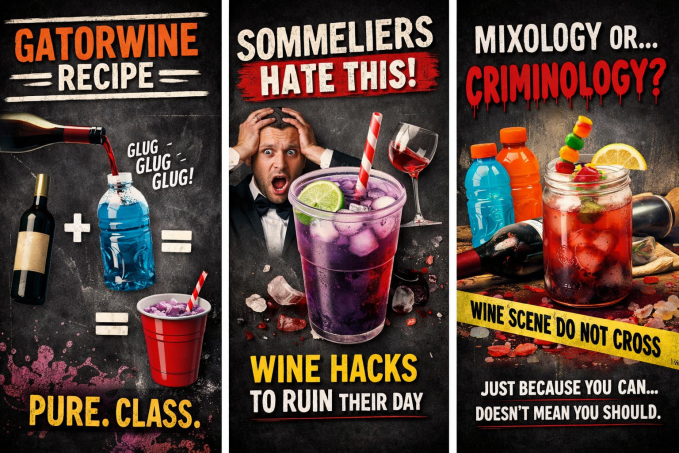
If you have not yet encountered Gatorwine, count yourself  lucky. The recipe is simple. Take red wine. Take Gatorade. Mix. Post. Smile. Repeat until engagement plateaus or your friends stage an intervention. Variations exist. White wine and electrolyte drinks. Rosé and soda. Ice cubes. Frozen jalapeños. Nothing is sacred. Everything is content.
This is not about taste. It was never about taste.
What these concoctions represent is not a collapse of wine culture but a mutation. Wine has entered its DIY phase, where rules are optional, vibes are mandatory, and repeatability is irrelevant. The goal is not the second glass. The goal is the clip.
Wine spent decades trying to convince people it was serious. Structured tastings. Scores. Sommelier theater. Ritual. Then TikTok arrived and asked a simpler question. Does this look fun?
Gatorwine looks fun. It looks rebellious. It looks like something that will horrify the right people. That alone guarantees views.
The real punchline is that wine has always been mixed. Sangria exists. Spritzes exist. Calimocho has been a thing forever. The difference is context. Those drinks lived in culture. They had a place. They were repeatable. They were meant to be consumed, not just documented.
Gatorwine is not trying to live on a table. It is trying to live on a feed.
And that matters.
Because what we are watching is wine drifting from a product  designed for shared moments into a prop for individual expression. The algorithm does not reward balance or restraint. It rewards novelty. It rewards transgression. It rewards things that feel like inside jokes, even if no one wants to drink them twice.
This is how wine becomes merch.
You do not need to like Gatorwine to understand it. You just need to recognize the conditions that created it. Younger drinkers are less interested in hierarchy. Less patient with rules. Less impressed by authority. They are comfortable remixing everything. Music. Fashion. Identity. Wine was never going to be spared.
The mistake the wine industry keeps making is assuming these moments are attacks. They are not. They are signals.
The signal is this. Wine feels inaccessible enough that breaking it feels satisfying.
That should worry people more than Gatorade in a Bordeaux.
Because when wine culture becomes brittle, people stop trying to participate correctly and start participating loudly. Mixing wine with sports drink is not about hydration or flavor. It is about saying, this is mine now. You do not get to tell me how to enjoy it.
The internet did not invent this impulse. It just gave it amplification.
Here is the uncomfortable truth. For every Gatorwine video  that makes you cringe, there are ten people who saw wine as something they were not invited into until someone made it silly enough to approach. That does not mean we celebrate the crime scene. It means we understand the motivation.
The danger is not that wine is being mixed. The danger is that wine is becoming forgettable.
If the only way it breaks through is by being abused for clicks, then the category has already lost its narrative grip.
Wine X is not here to defend Gatorwine. It is here to ask why the industry left so much empty space that Gatorwine rushed in to fill it.
Make wine legible. Make it human. Make it repeatable. Make it worth a second glass.
Do that, and the internet will still do dumb things. But they will do them around wine they actually want to drink.
And Kyle can keep his electrolyte blend. We will take the bottle.